
News & Events
Leading Through Change with Confidence

Let’s talk about leadership during times of change and consider where to focus your energy.
Focusing Your Energy Where It Matters Most
Change is a constant feature of modern organisations with many internal and external influences. New technologies emerge, markets shift, policies evolve and expectations of work continue to change. It feels like there is always something new demanding attention. For leaders, this can sometimes feel overwhelming and for their employees too.
One of the most helpful questions leaders can ask during periods of change is a simple one: Where should I focus my energy?
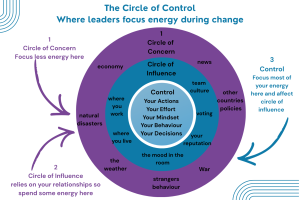
A useful way of thinking about this is through the idea of the Circle of Control, a simple model that helps leaders distinguish between what they can control, what they can influence and what simply sits beyond their reach.
Understanding the Circle of Control
When people experience change, it is natural to think about the wider forces affecting them. News cycles, global events, political decisions or economic uncertainty can dominate conversations and shape how people feel. These factors matter, but they often sit outside a leader’s direct control.
Spending too much time and energy worrying about external factors can create frustration and distraction. Leaders may feel reactive rather than purposeful, responding to events rather than guiding their teams through them and failing to focus on organisational goals.
The Circle of Control model offers a practical way to shift that perspective, read on to discover how.
What Leaders Can Control
At the centre of the model is the Circle of Control. These are the things that sit firmly within a leader’s own responsibility.
They include your:
-
actions
-
effort
-
mindset
-
behaviour
-
decisions
During times of uncertainty, these are the foundations of effective leadership. While external events may shape the environment, leaders still choose how they respond and direct their energy effectively.
For example, a leader cannot control how the market behaves or how quickly change happens across an industry. But they can control how clearly they communicate with their team, how they approach challenges and how they model resilience and professionalism.
These choices have a powerful impact on how others experience change.
Where Influence Matters
Beyond what we directly control sits the Circle of Influence. This includes areas where leaders can shape outcomes through relationships, communication and example.
Within this space we consider:
-
Team culture
-
The mood within a team or organisation
-
Reputation
-
Relationships with colleagues
-
The experience people have at work
Leaders cannot command these outcomes directly, but they can influence them. The way a leader listens, supports others, encourages collaboration or recognises contributions can significantly affect how a team navigates change.
When leaders consistently focus on what they can control, their influence naturally expands. Teams often respond positively to clarity, consistency and thoughtful leadership.
Why People Resist Change
Before leaders can successfully guide others through change, it is important to understand a simple truth: resistance to change is a normal human response!
People are not always resisting the change itself. Often they are responding to uncertainty, perceived loss or a lack of clarity about what the future will look like.
Several common psychological factors can influence how people react to change:
- Loss aversion
People tend to focus more on what they might lose than what they might gain. - Reactance bias
When individuals feel change is being imposed on them without choice, they may resist in order to protect their sense of autonomy. - Ambiguity
Uncertainty about what the change means in practice can create anxiety. - Hindsight bias
People may look back at the past and believe previous approaches worked better than they actually did. - Anchoring
Early impressions about the change can strongly shape later attitudes. - Status quo bias
Many people prefer familiar routines, even if improvement is possible. - Negativity bias
Negative possibilities often receive more attention than potential benefits.
Understanding these reactions helps leaders respond with empathy rather than frustration. Instead of assuming resistance is purely negative, leaders can view it as a signal that people need more clarity, reassurance or involvement in the process.
Supporting People Through Change
When leaders recognise why people resist change, they are better able to support their teams.
Clear communication, opportunities for discussion and visible leadership behaviours all help people move from uncertainty to engagement.
Leaders who focus on what they can control such as their actions, behaviour and communication are the ones who inspire the most confidence during uncertain times.
A Practical Reflection Tool
The Circle of Control model works well because it is simple and practical. It encourages leaders to pause and reflect before reacting.
When facing a difficult situation or a moment of uncertainty, a leader might ask:
-
What part of this situation is actually within my control?
-
Where can I influence outcomes through relationships or communication?
-
What concerns might I need to acknowledge but not focus my energy on?
This shift in thinking can create clarity during moments when change feels confusing or overwhelming.
Leading Through Change with Confidence
Periods of change often test leadership. They require people to navigate uncertainty while supporting others and maintaining focus on organisational goals.
The Circle of Control does not remove complexity, but it helps leaders focus their attention where it can have the greatest impact.
When leaders concentrate on their actions, effort, mindset and decisions, they create stability for the people around them. Over time, this clarity strengthens trust and increases their ability to influence positive outcomes.
In uncertain environments, leadership is rarely about controlling every situation. More often, it is about understanding where your energy is best placed.
So when times feel tough remember to ask yourself: What is within my control right now?